Analysis
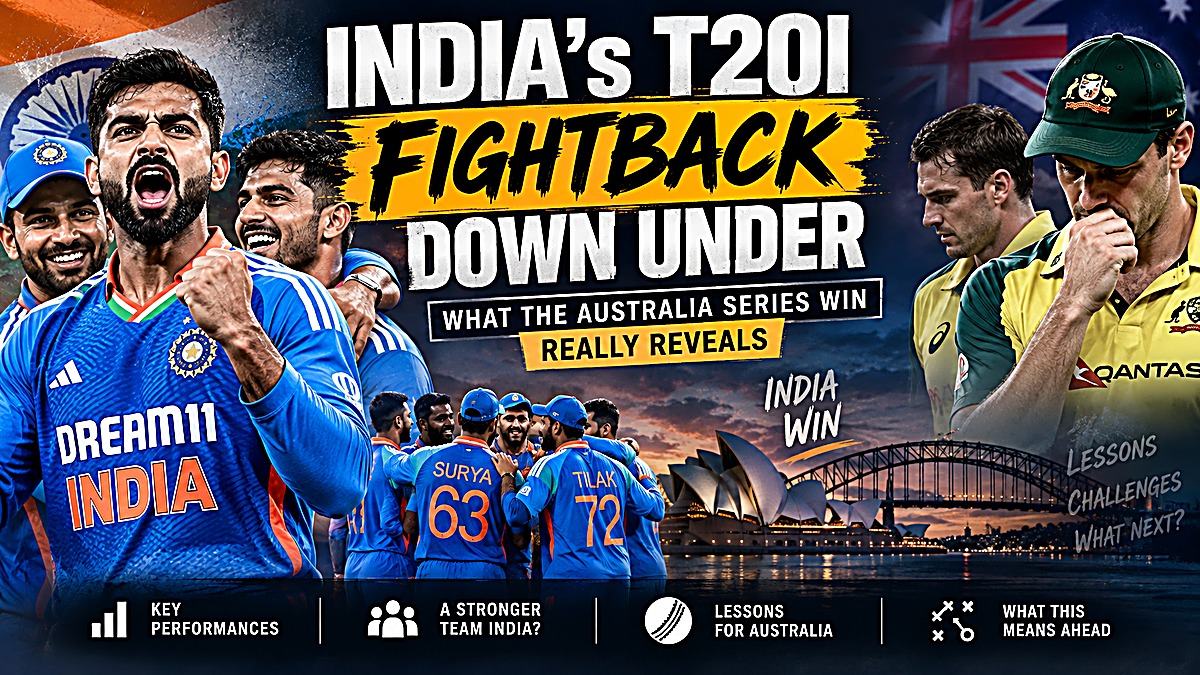
India levelled the ledger with a 2-1 T20I series win after losing the ODIs, and the fallout points two very different ways for both sides.
India's white-ball tour of Australia, played across the 2025-26 international summer, ended the way many of these trips do these days: split down the middle, one series apiece, and plenty for both dressing rooms to take home. <cite index="4-2">The tour ran from 19 October to 8 November 2025</cite>, with Shubman Gill leading India in the ODIs, Suryakumar Yadav in charge for the T20Is, and Mitchell Marsh captaining Australia across both formats.
Australia struck first with bat and ball working in tandem across the 50-over leg. <cite index="4-5,4-6,4-8">Australia won the three-match ODI series 2-1, with Matthew Short their leading run-getter and Rohit Sharma India's, Rohit going on to be named Player of the Series with 202 runs</cite>. Harshit Rana was the standout with the ball on either side, while Adam Zampa did the containing job for the hosts - but it wasn't enough to stop India levelling the ledger once the tour moved to T20Is.
The shortest format flipped the script entirely. <cite index="4-10,4-11,4-13">India won the five-match T20I series 2-1, with Abhishek Sharma the standout batter on 163 runs, well ahead of Australia's Tim David, and duly named Player of the Series</cite>. With the ball, <cite index="4-12">Nathan Ellis finished as the series' leading wicket-taker with nine, while Varun Chakravarthy picked up five for India</cite>. Ellis's haul is a reminder that Australia's attack asked hard questions throughout - India's top order simply found answers more often.
For a side that has built its T20I identity around fearless strokeplay at the top since winning the 2024 World Cup, watching Abhishek Sharma dominate on quick, bouncy Australian surfaces is a genuinely useful data point. Scoring heavily on flat, dry Indian pitches is one challenge; doing it against extra pace and steeper bounce is another altogether, and it's exactly the kind of examination India need their batters to keep passing. Suryakumar Yadav's leadership also earns credit here - engineering a series win having just watched the ODI squad lose days earlier shows a group capable of resetting fast between formats, a trait that will be tested repeatedly through a crowded 2026 calendar.
That form didn't stay in Australia either. <cite index="9-10,9-11,9-13">India followed up with a 4-1 T20I series win over New Zealand at home in January 2026, Suryakumar Yadav again topping the run charts with 242 and again taking the Player of the Series award</cite>. Two series, two continents, the same pattern - and that kind of consistency is precisely what a team wants heading into a global tournament on home soil.
Australia used the tour to keep widening their options rather than sticking rigidly with a settled XI. <cite index="8-2,8-3">Mahli Beardman, Glenn Maxwell and Josh Philippe were added to the T20I squad during the series, with Tanveer Sangha drafted in on 27 October</cite>, and, tellingly, <cite index="8-4">Travis Head was released from the T20I squad on 3 November</cite>. That level of squad turnover mid-series usually points to a team using bilateral cricket to stress-test depth rather than chase the result at any cost - a reasonable strategy with a home T20 World Cup cycle still to plan around, even if it meant surrendering the series.
India won the five-match T20I series 2-1, bouncing back after losing the preceding three-match ODI series 2-1 to Australia.
Abhishek Sharma was named Player of the Series after finishing as the leading run-scorer with 163 runs, ahead of Australia's Tim David.
Australia's Nathan Ellis was the leading wicket-taker in the series with nine scalps, while Varun Chakravarthy led India's bowlers with five.
Yes, Mahli Beardman, Glenn Maxwell and Josh Philippe were added mid-tour, Tanveer Sangha joined on 27 October, and Travis Head was released from the T20I squad on 3 November.
Dropping a home T20I series 2-1 is never comfortable, especially with Nathan Ellis bowling well enough to finish as the leading wicket-taker on either side. But Australian cricket has long treated bilateral T20Is between global events as an experiment lab, and recalling an experienced hand like Glenn Maxwell alongside fresher faces such as Beardman and Philippe fits that habit perfectly. The bigger worry is a top order that struggled against India's variety - Varun Chakravarthy's mystery spin in particular found gaps that better sides may not offer again.
Bilateral T20I results rarely define careers on their own, but patterns matter, and the pattern here is clear enough. India left Australia with a series win and carried that form straight into a home series against New Zealand, underlining where the T20I side stands under Suryakumar Yadav's captaincy. Australia, by contrast, look like a team mid-renovation - absorbing defeats, rotating personnel, and banking information for the tournament that will actually decide reputations. Both approaches make sense on paper. Which one pays off will only become clear once the cricket that matters most gets underway.